Design as Fluid Thinking in Andrea Branzi by Toyo Ito
An exhibition at the Milan Triennale rekindles the critical and radical philosophy of the Italian master.

“Andrea was, among all of them, the one who most closely resembled a thinker rather than an architect or designer. He never stopped asking himself: what is design? What is architecture? What is the city? I believe he saw the practice of designing buildings or furniture as a vain attempt, similar to ‘bubbles floating in backwaters,’ as Kamo wrote in Chōmei.”
Toyo Ito
Test Title
A critic of the rigidity of industrial rationalism and a central figure in contemporary design culture, Andrea Branzi (1938–2023) kept his reflection in constant metamorphosis. From radical experiments with Archizoom, which questioned the dogmas of modernism, to the drifts of the new Italian design in Alchimia and Memphis, his philosophical work unfolds organically in consonance with the city he investigated.
Conceived by Toyo Ito in collaboration with Lorenza Branzi and Nicoletta Morozzi, and curated by Nina Bassoli and Michela Alessandrini, the exhibition Andrea Branzi by Toyo Ito Continuous Present at the Milan Triennale brings together more than 400 works—environmental installations, maquettes, drawings, objects of different scales, and archival documents. Although it seems to follow a biographical spectrum, the journey is organized in overlapping layers of thought. Without linearity, center or periphery, just like the philosophy of the Italian master.
It follows design as a critical practice that intersects scales, disciplines, and modes of coexistence. It echoes the multidisciplinary vision of the thinker-architect, designer, and artist, for whom the act of designing is more about questioning than resolving.

Andrea Branzi By Toyo Ito Continuous Present | Foto: Andrea Rossetti © Triennale Milano


Andrea Branzi By Toyo Ito Continuous Present | Foto: Andrea Rossetti © Triennale Milano
“It belongs neither to the past nor to the future, but to a continuous present. It is not something precisely articulated; it belongs to another type of intellectual process that is still part of me, regardless of time and distance from my most recent work.”
Andrea Brazni


Andrea Branzi (2012) | Photo Elisabetta Claudio

No-Stop City, Archizoom Association. Project for the Residential Park, 1969.
Digital image, The Museum of Modern Art, New York / Scala, Florence | Courtesy MoMA
Works in progress
Branzi's discourse on the emblematic No-Stop City project (1969–72) takes shape in this 1:1 scale installation. A critical schematic of the modern city, it delineates a continuous city, without center or boundary, that never existed outside of the drawing board. A homogeneous space that expands infinitely, without beginning or end. In continuous transformation, detached from architecture, hierarchy, and functionalist logic.

Pineta di Architettura 2006, Andrea Branzi | Photo: Daniel Kukla/Courtesia Friedman Benda and Andrea Branzi
The circuit changes its status, becoming arranged through linked approximations. Ellipse and Gazebo, from Open Enclosures (Paris, 2008), reappear in the center and anticipate Record and Paradiso. Exhibiting is already projecting: the relationship between the works, their intervals and spatial arrangement constitutes part of the reflection that materializes there.


Andrea Branzi By Toyo Ito Continuous Present | Photo: Andrea Rossetti © Triennale Milano

Andrea Branzi By Toyo Ito Continuous Present | Photo: Andrea Rossetti © Triennale Milano
With interior and furniture designs, Case a pianta centrale creates living nuclei. It echoes the philosophy that interiors should be understood "as a way of updating the city with functions and activities that traditional architecture cannot offer. A kind of urban evolution made from the inside out." The Animali Domestici series makes tangible other ways of living and coexisting. Constructed from symbolic elements, the domestic environment is configured as a cultural construction.


Animali domestici, 1985, Andrea Branzi | Courtesy Andrea Branzi Collection
In Oggetto Ibrido, nature and artifice, fragility and construction intertwine. They intensify forms and expand the possibilities of matter. The object remains as an experiment, in the encounter between different logics. It suspends the centrality of function. It opens itself to new ways of perceiving, touching, and thinking.

Grandi Legni an Etchings exhibited at Nilufar in 2022. Monumental totems by Andrea Branzi, protectors with soul, dialogue with engravings of mythical dimension | Photo: Ruy Teixeira/Courtesy of Nilufar
At the conceptual apex where Branzi intertwines with Ito's mediation, design and experience illuminate the anthropological dimension. The city inhabits the continuous present, fragmented into fleeting forms, rhythms, and atmospheres, on the verge of revealing itself. In his text for the exhibition, Toyo Ito recalls Kamo no Chōmei: “The river's flow is incessant, and its water is never the same. The bubbles that float in the backwaters, sometimes disappearing, sometimes forming, do not last long.” The question remains: could this city ever emerge as a reality, or does it occur within the flow that reveals it, as it is conceived and lived?

A section of the Robin Hood Gardens facade, designed by Alison and Peter Smithson, is now on display at the V&A East Storehouse in London.




MASP, Lina bo Bardi
The origins of brutalism
The current appeal of brutalism dates back to the late 2000s and early 2010s, when a series of academic books—such as Owen Hatherley's Militant Modernism (2009)—exhibitions (such as "Le Corbusier: The Art of Architecture" at the Barbican Gallery in the same year), and TV programs marked a renewed interest in postwar modernist architecture, encouraging its re-evaluation. As a result, buildings previously seen as outdated or oppressive have gradually come to be recognized as culturally significant.
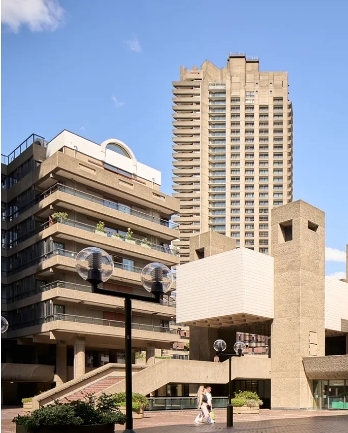
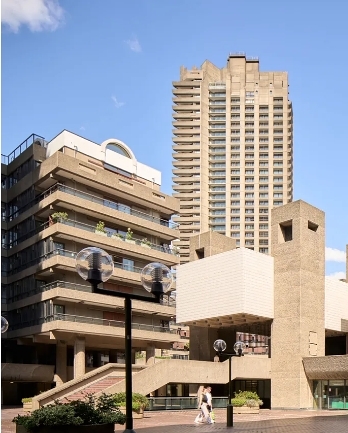
From the Barbican in London and Park Hill in Sheffield to the Hansaviertel and Karl-Marx-Allee in Berlin, many postwar projects have gained recognition not only for their architectural ambition but for what they reveal about the social ideals of their time. This was formalized through heritage listings: in 2008, several modernist housing complexes in Berlin were declared UNESCO World Heritage Sites, followed in 2016 by the inclusion of a group of works by Le Corbusier. All of this signaled a broader shift in how Brutalist and late Modernist architecture came to be perceived and reconsidered in relation to the circumstances in which it was built—a period marked by reconstruction, housing shortages, and a belief in collective provision.
Alongside this critical reassessment, a new trend emerged in online publications and culture. A growing number of books and visual platforms began presenting Brutalist architecture through highly stylized photographs, often detached from their social or historical context. Concrete became a visual shortcut: graphic, monumental, and abstracted from everyday use. As these images spread—driven by platforms like Tumblr, Flickr, and later, Instagram—brutalism came to be understood more for its appearance than its purpose.
The future of brutalism
The fate of the Robin Hood Gardens complex in east London aptly illustrates this issue. Designed by the Smithsons as a model of post-war social housing, the development was widely praised by architects and historians, but was eventually demolished in 2017. Its destruction exposed the limits of aesthetic appreciation when there is no sustained public and political commitment. The challenge now is not only whether brutalism should be admired, but whether its fundamental values can once again be taken seriously—so that it is not reduced to superficial appreciation. As long as architecture cannot once again prioritize collective purpose over appearance, brutalism will continue to be misunderstood—celebrated in images, but emptied of the social conviction that once gave it meaning.